
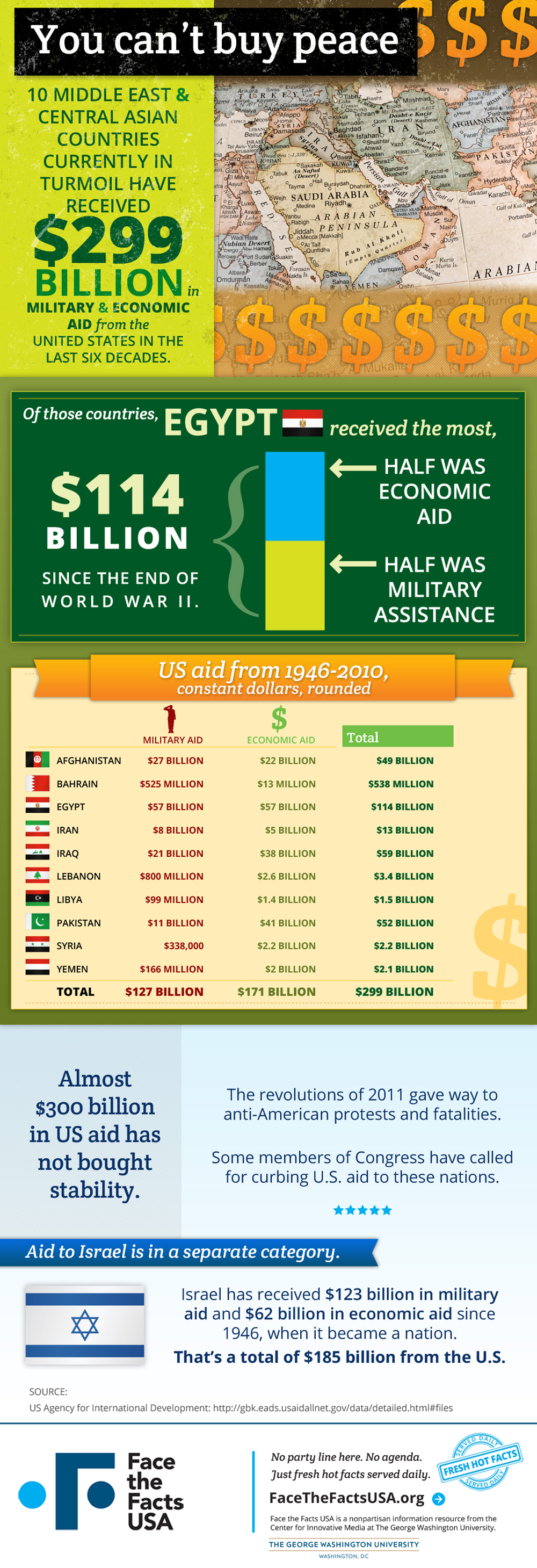
The U.S. has sent almost $300 billion in military and economic aid to troubled Middle East and Central Asian countries over the past six decades, Egypt first among them - but the results suggest that we can't just buy peace.
Violence rages in Egypt today as the protests and accompanying crackdown of the last week continue. The country has been on edge ever since the military, led by General Abdul Fattah al-Sisi, toppled the government of Mohammed Morsi, but the violence took a sharp upward turn last week, with the death toll topping 800 people by Sunday night.
The political issue of the day in Washington has become aid to Egypt. With violence on all sides, should the $1.3 billion in aid allocated to Egypt be cut off? Lawmakers are sounding off, and not in polite terms. Today, we take a look back at key facts behind this debate - how much aid we give to Egypt and the region, and how little stability it has bought.
Over the last six decades, the U.S. has invested $299 billion in military and economic aid for Middle East and Central Asian countries currently in turmoil. Egypt tops a list of 10 nations, receiving $114 billion since the end of World War II. Iraq comes in second, getting nearly $60 billion from the U.S. (over and above war costs).
Far outpacing those ten countries is Israel, an ally that got another $185 billion in U.S. aid in the same period.
What did all that money buy the U.S.? Neither regional stability nor automatic support. In fact, some lawmakers want to pull back U.S. aid. Others, though, say that "buying stability" is not the goal of this aid, and it is worth the small fraction of the budget it takes up - about 1 percent.
Check out our infographic for more on where the money went. See “What Do Others Say” for more opinions on U.S. aid abroad, then add yours to the discussion below. How much should we be giving to troubled countries? What should we expect in return? If a country descends into violence, like Egypt has, should the aid continue?